Guides
Hiring and training a catering team that shows up on event day
A useful answer to 'catering hiring guide' starts with the work the team must deliver reliably, not with a borrowed benchmark. Strong plans make assumptions.
Weak version / Better version: Treat attendance as an event-day system
Better attendance comes from visible expectations, a confirmation routine and a backup plan that someone besides the owner can run. Keep the focus on practical signals: whether staff answer before the event, know where to report and can be replaced without leaving a critical station uncovered.
Weak version: Assume that accepting a shift means a person will appear, then start calling around after the first absence. A backup arrangement kept in the owner's memory is hard to use under pressure, especially when the event manager is also trying to protect service and answer guest questions.
Better version: Text each worker 72 hours and again 24 hours before the shift, recording replies both times. Send a call sheet with arrival time, station, uniform, parking details and the captain's phone number. Keep trained event standbys for events above 100 guests, and write down who contacts them.
Weak version / Better version: Describe the work before recruiting
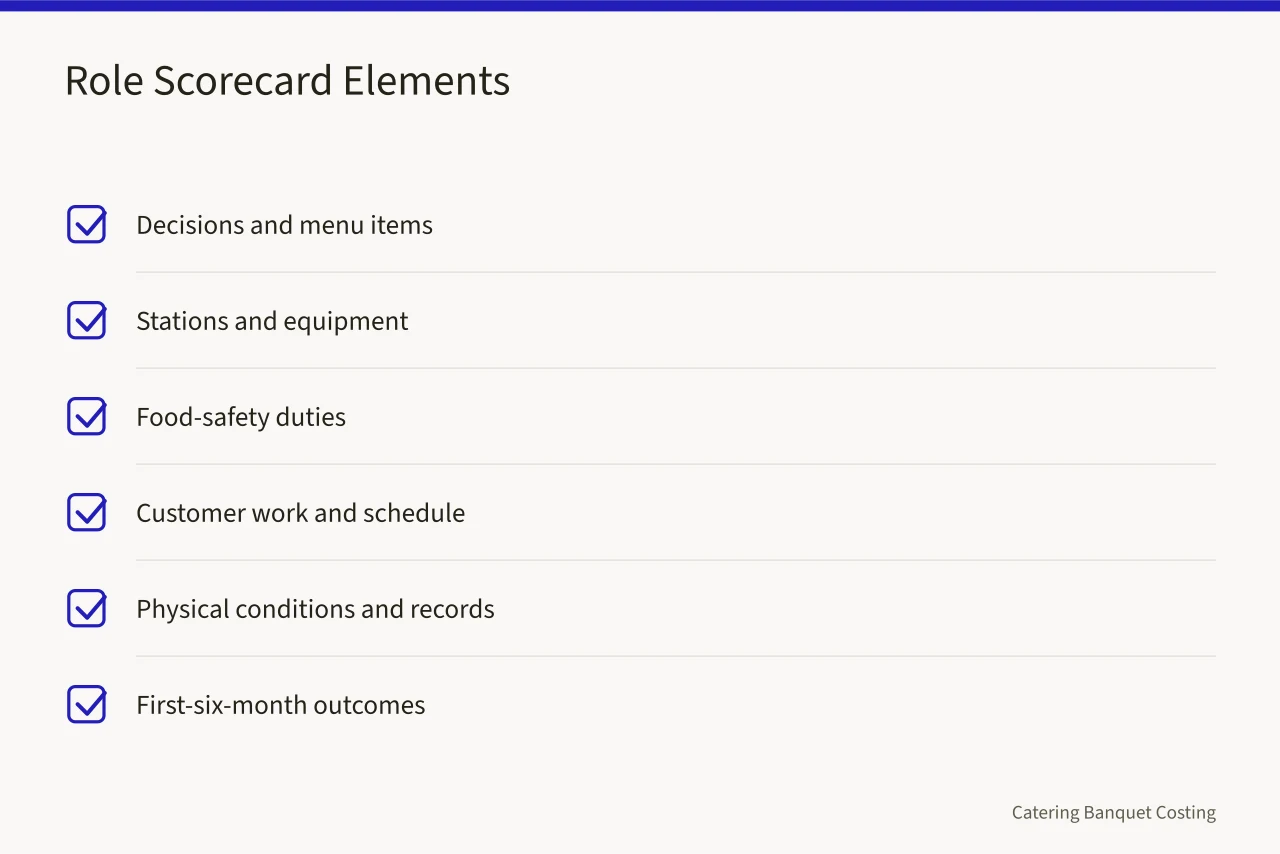
A role is easier to fill reliably when applicants can see the actual shift and duties before accepting it. Define each position by station, start time, tasks, equipment, food-safety responsibilities and the result expected during the first 90 days.
Weak version: Post a broad request for banquet staff and decide what the person should do after they arrive. That can leave new workers guessing about who makes decisions, which equipment they may use and when to raise a concern instead of improvising.
Better version: Prepare one written scorecard for each role, including captains, servers, licensed bartenders, prep and line cooks, dish staff, drivers and the event manager. Include an escalate-to contact and describe standing, lifting, heat, weekend work and late finishes. A role scorecard plan can help make the expectations usable during training.
BLS descriptions for food service managers and head cooks help distinguish banquet-cook duties from sous-chef duties. Make the equipment, physical demands and first-shift expectations clear enough that applicants can decide whether the position suits them before accepting an interview.
Weak version / Better version: Match the recruiting source to the shift
Use more than one recruiting channel, because the source that works for a cook may not provide a last-minute dishwasher. Referrals, school placement offices and staffing agencies each have different lead times and trade-offs, so select the channel according to the role and the date you need covered.
Weak version: Depend on a single source and expect it to provide every position on short notice. An agency can fill dish or prep work quickly, but its hourly markup matters, and the employer should confirm that workers' compensation cover is in place.
Better version: Ask current employees for referrals and pay the referral bounty through payroll. A typical bounty is $150 to $300 after the new employee remains for 90 days and works two Saturday events. Contact hospitality and culinary placement offices in March and September, allowing for their academic calendar.
| Recruiting channel | Roles it can suit | Typical lead time | Check before relying on it |
|---|---|---|---|
| Staff referral | Servers, captains, dish staff | 1 to 3 weeks | Whether the referral is a good fit |
| School placement office | Cooks, prep and pastry staff | 4 to 10 weeks | Semester timing |
| Staffing agency | Dish, prep and urgent cover | 24 to 72 hours | Hourly markup and workers' compensation cover |
Weak version / Better version: Set pay with local evidence
Set a pay band using comparable local jobs, then decide its upper limit before interviews begin. National figures can orient the comparison, but they do not replace checking current advertisements for the same role, schedule, experience and equipment responsibilities in your own market.
Weak version: Copy one national average and assume it will attract applicants for weekend event work. Pay and event labor are addressed in more detail in the catering labor-cost breakdown, while local postings show what candidates can compare against nearby.
Better version: Once a year, and again after losing two candidates in one month, check the BLS median pay for waiters, then gather 10 to 15 current postings within 30 miles. Compare weekend expectations, experience and equipment duties, set a band, and decide its ceiling before the first interview.
A published wage range is a starting point rather than a quote for your market. In Ontario, the Employment Standards Act sets minimum-wage and overtime requirements, while public-holiday premiums affect banquet labor; check Ontario banquet wage rates when planning those shifts.
A mandatory service charge is not a tip. Check IRS tip guidance for its tax and distribution treatment, and use the pricing and profit guide to account for a wage change in the event quote.
Weak version / Better version: Judge evidence, not interview polish
A consistent scoring sheet makes it easier to compare applicants on reliability, pace, sanitation and guest recovery. Use the same four prompts for every candidate, rate each answer from 1 to 5, and move applicants scoring 16 or more out of 20 to a paid trial shift.
Weak version: Let a confident manner outweigh an answer that lacks a real example. A low score should reflect no useful evidence, a middle score a broad example, and a top score a specific account of the event, station, guest count and response.
Better version: Ask candidates about a recent banquet and their station, how they responded when work fell behind, what they would do after an allergen concern, and whether they can confirm the next three weekends. Record the response under the same four categories, and do not substitute charm for evidence.
Weak version / Better version: Clear the basics before the paid shift
Complete a short, consistent hiring sequence before placing a new worker on the rota. Posting the shift pattern up front helps people rule themselves out if they cannot work it, while a brief call and paid trial can test the practical fit before an offer is made.
Weak version: Skip the availability check, then discover that a candidate cannot work the event hours or reach the venue. A rushed offer can also leave start rate, schedule, probation period or uniform costs unclear to the person accepting the job.
Better version: State the shift pattern in the job post, then use an 8 to 10 minute phone screen to confirm availability, transport, food-handler-card status and pay expectations. Arrange a paid working interview lasting 3 to 4 hours on an event, with tasks such as plating salads, carrying a tray and restocking a buffet.
Call two former supervisors about attendance, late cancellations and notice. Before the first paid shift, complete I-9 Section 1 on day one and Section 2 within three business days, verify the food handler card with its issuer, record age and check the alcohol permit for bartenders who pour. The licensing and compliance guide covers related records and requirements.
Weak version / Better version: Make station sign-off the gate to solo work
Use a supervised path from paperwork to independent station work, with a written check at each stage. The purpose is not to rush a new hire onto a busy event, but to confirm that the person can repeat essential tasks and knows when to ask for help.
Weak version: Give a new employee a quick tour, then treat attendance at one event as proof of competence. That leaves no record that the person can handle an allergen question, document cooling or set tables to the house pattern.
Better version: Use a 14-day progression through paperwork and food-safety orientation, supervised prep and service, a full-event shadow, then a station run checked by a captain before solo work. Sign off each stage, keep the record in the personnel file and review performance against the scorecard at days 30, 60 and 90.
Workers under 18 face restrictions on hazardous kitchen equipment and working hours, and state rules may be stricter. Keep reference labels such as I-9 Central, FLSA, child labor rules, employment taxes, safe food handling and food safety guidance with the personnel process. The sourcing and inventory guide can help set product specifications and yields that staff need to repeat.
Weak version / Better version: Recover quickly and keep dependable people
Reliability improves when expectations are repeated, absences are logged and the backup response is decided before an event. Track late arrivals and no-shows by name, and address two unexplained no-shows with a conversation rather than waiting for another event-day failure.
Weak version: Improvise coverage after a callout and leave the crew unsure who is taking the open station. If a server calls two hours before service, that confusion can spread across the floor while the manager tries to protect the guest experience.
Better version: For an urgent absence, call the standby list, move the captain onto the floor and have the event manager run the pass. Protect plated service and the bar first. Hold a 10-minute pre-service huddle to confirm stations and the final guest count, then record monthly no-shows and callouts using the scheduling and KPI guide.
Start recruiting four to six weeks before a seasonal peak, since onboarding takes 14 days and a standby needs a shadow event before counting on them. Publish schedules two weeks ahead, state payday during the interview and keep the weekly pay date consistent. Give the strongest servers first choice of premium dates; predictable work can help retain staff beyond one season.