Guides
What should a realistic catering startup budget include?
Owners researching 'catering startup guide' need more than a generic checklist. They need to separate food safety, event readiness, service, and customer goals from.
What to take away
- A realistic launch in the United States typically costs $25,000 to $60,000 for a drop-off and staffed-buffet caterer renting shared kitchen time. A dedicated buildout usually passes $120,000.
- Register the entity and pass the health permit before buying equipment. Most United States caterers answer to a county or city health department, not the FDA.
- One-time costs such as deposits, permits, equipment and opening inventory belong on a separate sheet from monthly costs such as rent, insurance, software and payroll. Only the monthly total sets your break-even guest count.
- Hold four to six months of fixed costs as working capital. Space, utility and venue deposits fall due before your first paid event.
- Clear health, fire and business licensing before you sign a lease. The licensing and compliance steps a caterer must clear before opening sets out the order to work in.
What decides the total
Three choices move the number more than any single line item: how you produce food, how you serve it, and where you sell it.
A rented commissary slot costs a fraction of a leased kitchen with a hood, grease trap and three-compartment sink. That gap dwarfs the equipment list.
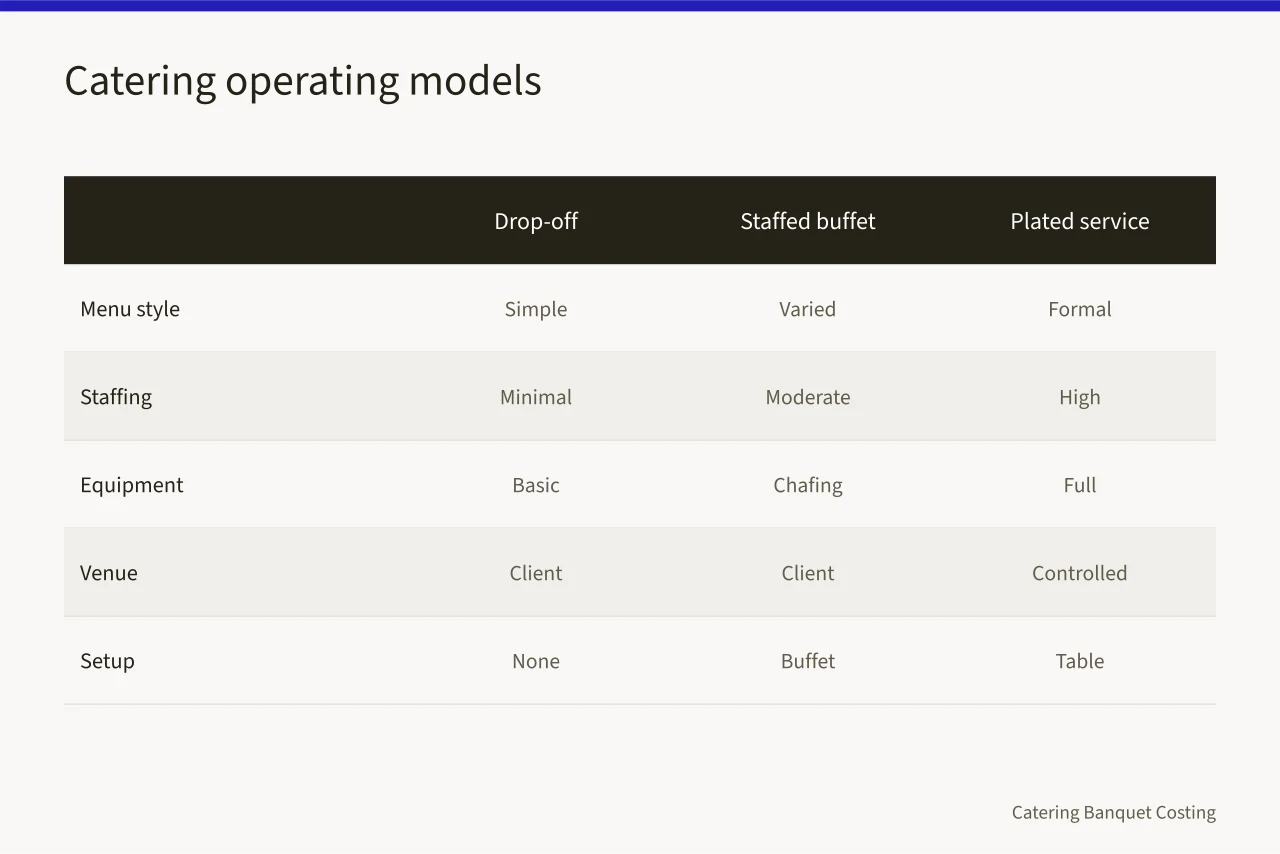
Service style adds labor and rentals rather than equipment. A plated dinner for 120 guests needs captains, servers, china and a site visit. Drop-off boxes need insulated transport and a reheating plan instead.
The line-item startup budget
Treat these as typical ranges for a mid-size United States market, not as quotes. Replace them with written quotes as soon as you have them.
| Category | Typical range | Type |
|---|---|---|
| Entity filing and EIN | $50 to $500 | One-time |
| Space deposit | $1,000 to $6,000 | One-time |
| Health permit and business license | $200 to $1,200 | One-time |
| Buildout: hood, sinks, grease trap | $15,000 to $90,000 | One-time |
| Refrigeration and hot holding | $6,000 to $25,000 | One-time |
| Smallwares, thermometers, scales | $1,500 to $5,000 | One-time |
| Opening inventory and disposables | $2,000 to $6,000 | One-time |
| Packaging, labels, allergen tags | $600 to $2,500 | One-time |
| Commercial general liability | $1,200 to $4,000 | Recurring, yearly |
| Used cargo van | $12,000 to $35,000 | One-time |
| Van lease and auto insurance | $400 to $900 | Recurring, monthly |
| Quoting and costing software | $100 to $400 | Recurring, monthly |
| Recruiting, uniforms, food handler cards | $500 to $2,500 | One-time |
| Launch marketing and photography | $1,500 to $6,000 | One-time |
| Working capital reserve | Four to six months of fixed cost | Cash |
Two rows spoil most first drafts. Owners total the equipment quote, then meet the deposit, insurance and first inventory bills with nothing left.
Insurance is priced by event type, alcohol service and vehicle use, so insurance costs for a catering business, coverage by coverage belongs in the plan before you sign a van lease.
Building the budget in five steps
The SBA business guide groups startup work into planning, launch, management and growth, which is a workable frame for a cost sheet.
- Collect written quotes for space, equipment, insurance, permits and software.
- Tag each line as one-time or recurring, then move the recurring lines to a monthly sheet.
- Total the monthly sheet and divide it by your expected contribution per guest to find your break-even count.
- List deposits and first-month payments as cash needs, not as expenses.
- Compare both totals against the money you can fund and still hold in reserve.
Working capital and cash runway
Working capital covers the gap between paying suppliers and collecting event balances. Caterers buy food, ice, rentals and staff hours before the invoice is paid.
Hold four to six months of fixed cost and treat it as untouchable. A caterer can spend every dollar on a beautiful kitchen and still miss payroll in month two.
A $40,000 budget with $30,000 sunk into equipment leaves $10,000 for deposits, opening inventory, insurance and the first slow month. That is the version that closes.
Site terms decide how much cash leaves before opening, and lease costs and site terms worth negotiating before you sign covers deposits, buildout allowances and personal guarantees.
Example: a 60-guest drop-off launch
In an illustrative 60-guest order at $22 per head, the ticket bills at $1,320. If food and packaging take 32 percent, contribution is near $900.
A $14,000 launch carrying a $2,000 deposit, $2,500 of smallwares, $2,000 of opening inventory and $450 of permits needs about 16 events like that to recover the one-time spend.
Label the charge in the contract. A mandatory service charge is treated as wages rather than a tip, so the IRS guidance on tips and service charges is worth reading before you set the wording.
Example: one 120-guest buffet, priced end to end
A 120-guest buffet dinner at $54 per guest bills $6,480 before tax and service charge.
| Cost line | Amount |
|---|---|
| Food and beverage, 30 percent of sales | $1,944 |
| Server and captain labor | $1,390 |
| Kitchen labor | $720 |
| Rentals, transport and disposables | $650 |
| Insurance and admin allocation | $180 |
| Total direct cost | $4,884 |
| Contribution before overhead | $1,596 |
The order to follow, from entity to first invoice
- Register the entity.File with your state secretary of state, then get an EIN from the IRS.
- Confirm the kitchen is legal for catering.Most states bar catering from a home kitchen, and cottage food laws cap sales and forbid resale to venues.
- Apply for the health permit.Send plans to the county or city health department, pass plan review, then pass the pre-opening inspection.
- Clear fire and building checks.A fire marshal inspects hood suppression, extinguishers and exit routes before occupancy approval.
- Buy insurance before the first tasting.Venues ask for a certificate, so set liability, auto and workers compensation limits early.
- Write the food safety plan.Map the flow from receiving to waste, and keep raw and ready-to-eat work on separate paths.
- Build prices from your own costs.Food, labor, transport and disposables stay under 75 percent of contract value.
- Deliver one event and invoice it.Use a written contract, a 25 to 50 percent deposit and a signed guest count deadline.
Licensing, permits and demand cadence
The FDA states that food business requirements depend on the product and facility, and that retail food establishments are regulated by state and local government rather than registered with the agency. Budget the permit, the plan review and the follow-up inspection, because adoption of the FDA Food Code model varies by state.
Regulatory evidence points
- FDAHow to Start a Food Business
- SBABusiness Guide
- FDA Food Code 2022
- State and local licenses or permits
- Retail food establishment rules
- County or city health department:retail food permit, plan review and inspections.
- Local fire marshal:occupancy limits, hood suppression, extinguishers and exits.
- State revenue department:sales tax permit and a resale certificate.
- State labor department and the IRS:payroll registration and wage rules.
- Zoning board:a conditional use permit for a retail or residential kitchen.
- State alcohol authority:the liquor permit if you pour.
Corporate accounts order weekday lunches on repeat and short notice. Weddings book months ahead and pay deposits. Memorials arrive within days. Each pattern needs different capacity, which is why the catering business plan a lender expects to see should show the three separately.
Channel economics follow the same split. Twenty weekday deliveries spread fixed kitchen cost across a month; one Saturday wedding ties up the same kitchen for a single day.
In Canada, add GST/HST registration and Ontario minimum wage and overtime rules to the monthly sheet. Holiday banquets carry premium labor.